
Diversification represents one of those investment principles that sounds simpler than it proves in practice. For beginners in India, mutual funds offer accessible entry points for building a diversified investment portfolio.
As of October 2025, India’s mutual fund industry has reached an impressive ₹79.88 lakh crore in assets under management, more than six times the AUM of a decade ago.
Let’s take a look at how to diversify your portfolio, balancing growth potential with safety in ways suited to your financial goals.
Portfolio diversification means spreading investments across different asset types to reduce the risk of your entire portfolio. Instead of concentrating money in one asset class, diversification ensures that poor performance in one area gets offset by better performance elsewhere.
The concept isn’t about maximising returns from every holding. It’s about constructing a portfolio where the pieces move somewhat independently, so when one zigs, another zags.
In India’s dynamic market environment, where economic policies shift and global events ripple through domestic markets unpredictably, diversification helps protect investments from volatility and economic shifts that no one sees coming.
Mutual funds pool money from many investors to buy a range of equity and debt instruments, letting you own a diversified basket of securities even with modest capital. You’re essentially hiring professional fund managers to construct and manage that basket, saving you from researching hundreds of individual securities.
The growth of India’s mutual fund industry tells a compelling story about their increasing accessibility and popularity. The industry has experienced an over sevenfold increase over the past ten years.
In July 2025 alone, record inflows of ₹1.79 lakh crore were recorded, with investor participation reaching 25.19 crore folios; that demonstrates growing retail investor confidence in these instruments.
Also read: What is Loan Against Mutual Funds? LAMF Benefits, Eligibility & More
Different mutual fund categories serve distinct purposes in a diversified portfolio:
Equity Mutual Funds: Large caps provide stability and dividends, mid-caps offer growth potential, and multi-caps give fund managers flexibility to move between both as opportunities arise. The popularity of equity funds is evident; they account for approximately 61% of total AUM in India’s mutual fund industry, reflecting their importance in growth-orientated portfolios.
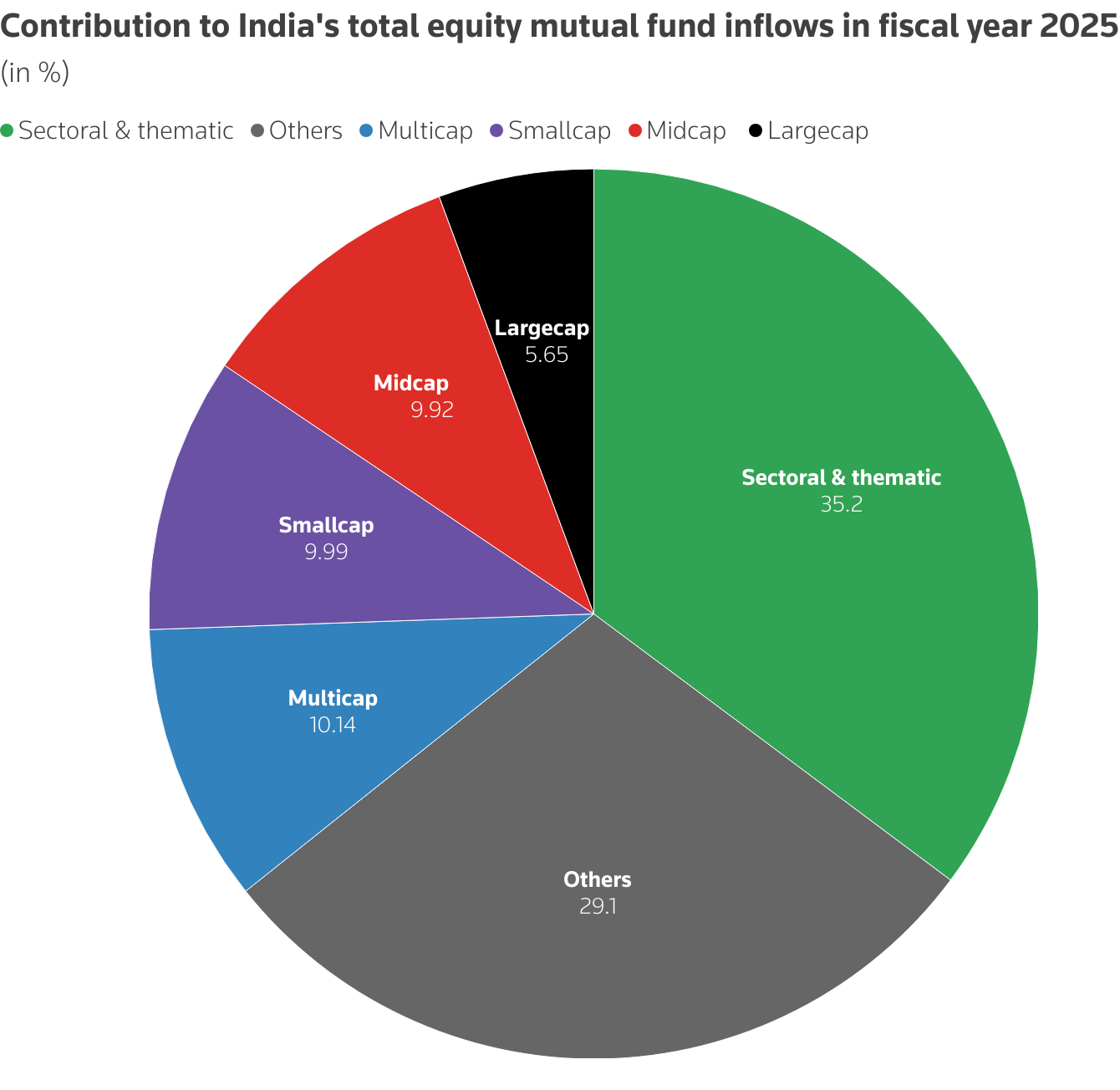
Source: Reuters
Debt Mutual Funds: Include government bond funds, corporate bond funds, and dynamic bond funds, providing income stability.
Hybrid Funds: These funds blend equity and debt within a single vehicle, offering moderate risk and return profiles. This kind of fund is ideal for conservative to moderate investors who want simplicity.
Multi-asset Funds: Spread investments across equity, debt, and gold for broad diversification that includes commodities. This approach mirrors the diversified investor interests visible across India’s mutual fund landscape.
Start by honestly evaluating whether you’re a conservative, moderate, or aggressive investor. Define your investment horizon: short-term (under 3 years), medium-term (3-7 years), or long-term (beyond 7 years). Longer horizons allow more aggressive equity allocations since you have time to recover from inevitable downturns.
Asset allocation matters more than security selection for most investors. An example for a moderate investor: 60% equity mutual funds, 30% debt mutual funds, and 10% gold or commodities funds.
Your specific allocation should reflect your circumstances. A 25-year-old starting their career can handle more equity than a 55-year-old approaching retirement.
Within equity funds, diversify across sectors and market capitalizations. It’s better not to invest in just three large-cap funds that all hold the same banking and IT stocks. Look for funds with genuinely different portfolios and investment philosophies.
Invest across multiple reputed mutual fund houses to reduce fund manager risk. Even excellent managers have bad periods, and fund houses occasionally experience issues affecting multiple schemes. Spreading across three or four quality fund houses protects against any single organisation’s problems impacting your entire portfolio.
SIPs allow regular investments that benefit from rupee-cost averaging and disciplined investing, reducing timing risk that destroys returns for those trying to guess market bottoms and tops. When you invest the same amount monthly, you automatically buy more units when prices are low and fewer when prices are high. Over time, this mathematical reality works in your favour without requiring any market timing skill.
The consistent growth in SIP participation, reflected in the record 25.19 crore folios as of mid-2025, demonstrates how this disciplined approach has helped millions of Indian investors.
Also read: SIP vs. Lump-Sum: Which Investment Strategy Is Better In 2026?
Globally, mutual fund assets reached over $80.85 trillion, with India holding a substantial and growing share. Improved financial literacy and digital platforms have made diversified investing mainstream rather than niche. Apps like Dhanush by Ashika now give investors easy access to build balanced portfolios, combining stocks, mutual funds, bonds, and more, all from their mobile devices and multi-platform access.
This guide provides educational information about portfolio diversification. Investment returns aren’t guaranteed and depend on market conditions.
Click here for more stock market blogs.
For more insightful articles and updates, follow us on Facebook and Instagram.
Open Free Demat Account!
In just a few minutes, Simply provide some basic personal details, to get started.
About | Research | Pricing | Upcoming IPOs | Blog | Become a Partner | RMS Policy | Privacy Policy
Fund Transfer for Trading | Fund Transfer for DP | Client Back office/DP Login | Partner Login | Buy-Back | Margin Calculation | Re-KYC | Downloads | Platform | Loans
CIN - U65921WB1994PLC217071 | SEBI Registration No. INZ000169130 | DP SEBI Reg ID : IN-DP-533-2020 | CDSL : 1234500 | NSDL : IN303591 | Member ID`s : NSE - 08334, BSE - 912, MSEI - 18300, ICEX - 1133, MCX - 56415, NCDEX - 1286 | AMFI : ARN-12417 | Research Analyst : INH000000206
Trinity, 226/1, A.J.C. Bose Road, 7th Floor, Kolkata - 700 020, India.
**Investments in securities market are subject to market risks, read all the related documents carefully before investing.





 retailbroking.ashikagroup.com