
As India gears up for the Union Budget 2026 on February 1, excitement is palpable among investors, businesses, and everyday citizens. Finance Minister Nirmala Sitharaman’s ninth straight Budget presentation comes at a time when the economy shows resilience despite global headwinds like rupee pressures and foreign outflows.
This Budget is a roadmap for Viksit Bharat amid strong GDP momentum and calls for inclusive growth. Today we will unpack what experts predict, from tax relief to stability, and Modi 3.0 priorities.
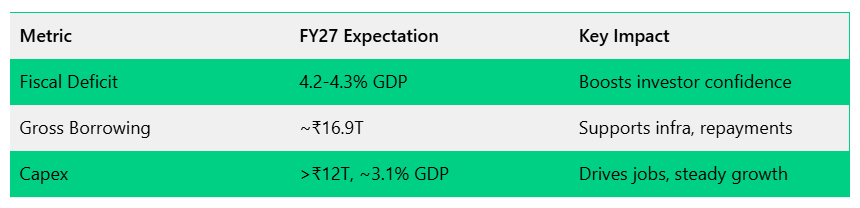
Fiscal discipline guides India’s Budget 2026 outlook, with economists projecting an FY27 deficit of around 4.2-4.3% of GDP, down from FY26’s targeted 4.4%, to build bond market trust amid global uncertainties like commodity spikes. This glide path assumes 10.5-11% nominal GDP growth, balancing consolidation with steady expansion as per SBI Research and ICRA forecasts.
Middle-class people top the wishlist, craving simpler slabs and exemptions in the new regime. There are broad expectations for relief under Sitharaman’s steady hand overhauls, but practical tweaks for households. Think easier compliance amid fiscal goals; it’s the common thread in live updates.
Logistics craves centre stage as India’s growth engine. Industry voices call for doubled infra outlays to ₹3 lakh crore, building on FY26’s ₹1.5 lakh crore state loans for highways, urban transit, and smart cities. Leaders like Logistics Sector Skill Council CEO Ravikanth Yamarthy stress skill upgrades, tech adoption, and sustainability to boost Atmanirbhar Bharat competitiveness.
Property players urge interest-free loan hikes and Credit Linked Subsidy Scheme (CLSS) revival for homebuyers. Construction eyes steady capex from FY26’s ₹11.21 lakh crore base, eyeing private spending, exports, and defence needs in airports, rail, and freight corridors. Green procurement by MoRTH, railways, and CPWD could slash emissions without cost spikes, aligning with Net Zero 2070.
Factories want sustained PLI focus and mega clusters blending OEMs, EMS, and suppliers. Defence manufacturing pushes for a 30% capex share to spark self-reliance. Consumer durables seek policy stability on solar PV, motors, and lighting—customs tweaks on raw materials to cut imports and build resilience.
Renewables demand backward integration incentives alongside data centres. Fintech eyes growth funds, GST rationalisation, R&D tax perks, and cybersecurity norms for consumer trust. Automation, AI, and electric gear top material handling wishes for efficient warehouses.
Healthcare and insurance hope for tax deduction hikes and new regime extensions. Defence, MSMEs, agriculture, and the digital economy round out the plays; think job schemes and structural spending.
The Union Budget 2026 on February 1 could define FY27’s trajectory. For investors and businesses, it’s a cue to watch key announcements closely, positioning for opportunities in high-potential areas. Whether you’re tracking market impacts or policy shifts, this Budget shapes the year ahead.
Source: News18
Open Free Demat Account!
In just a few minutes, Simply provide some basic personal details, to get started.
About | Research | Pricing | Upcoming IPOs | Blog | Become a Partner | RMS Policy | Privacy Policy
Fund Transfer for Trading | Fund Transfer for DP | Client Back office/DP Login | Partner Login | Buy-Back | Margin Calculation | Re-KYC | Downloads | Platform | Loans
CIN - U65921WB1994PLC217071 | SEBI Registration No. INZ000169130 | DP SEBI Reg ID : IN-DP-533-2020 | CDSL : 1234500 | NSDL : IN303591 | Member ID`s : NSE - 08334, BSE - 912, MSEI - 18300, ICEX - 1133, MCX - 56415, NCDEX - 1286 | AMFI : ARN-12417 | Research Analyst : INH000000206
Trinity, 226/1, A.J.C. Bose Road, 7th Floor, Kolkata - 700 020, India.
**Investments in securities market are subject to market risks, read all the related documents carefully before investing.





 retailbroking.ashikagroup.com